Timeline Activity photo.jpg
An official website of the State of Georgia.
The .gov means it’s official.
Local, state, and federal government websites often end in .gov. State of Georgia government websites and email systems use “georgia.gov” or “ga.gov” at the end of the address. Before sharing sensitive or personal information, make sure you’re on an official state website.
Still not sure?
Call 1-800-GEORGIA to verify that a website is an official website of the State of Georgia.
Grade Level: Middle and High School
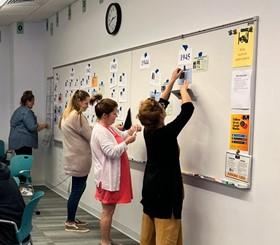
This lesson provides students with foundational knowledge about the history of the Holocaust. This activity helps students develop a timeline that integrates personal stories, key historical events, and Nazi laws and decrees. Additional categories include Holocaust literature (Elie Wiesel’s Night and Anne Frank’s Diary of a Young Girl).
As each layer is added, we can see how the events of World War II and the Holocaust slowly unfolded. We learn how the story of each person, each country, each event, is different. At the end of the activity, students can draw conclusions and develop questions about this difficult history.
At the conclusion of this activity students will:
Identify how the Holocaust unfolded differently in different geographic locations.
Resource Request: Holocaust Timeline Activity Cards
OR
You may download and print the cards.
Encyclopedia - Introduction to the Holocaust
Encyclopedia - Nazi Racial Ideology
Prior to beginning the lesson with students, place the timeline cards of each year horizontally around the classroom.
Students work in pairs or groups. Distribute the Individual Profile cards, and have students read for basic information, noting the following:
Questions to Consider
Students discuss their answers with their groups and then place the cards on the timeline, based on the year in bold on the card.
Distribute the Laws and Decrees cards, and have students read for basic information, noting the following:
Questions to Consider
Add these cards to the timeline.
Distribute the Historical Events cards, and have students read for basic information, noting the following:
Add these cards to the timeline.
Austria
Belgium
Czechoslovakia
Denmark
France
Germany
Greece
Italy
Lithuania
Poland
Romania
Soviet Union
Ukraine
3. What was the world response to the events of the Holocaust?
4. What do you see on the timeline that fits the definition of the Holocaust?
The Holocaust was the state-sponsored, systematic persecution and annihilation of European Jewry by Nazi Germany, its allies and collaborators, between 1933 and 1945. Jews were the primary victims - six million were murdered.
Roma (Gypsies), physically and mentally disabled people and Poles were also targeted for destruction or decimation for racial, ethnic, or national reasons. Millions more, including the LGBTQ community, Jehovah's Witnesses, Soviet prisoners of war, and political opponents also suffered grievous oppression and death under Nazi tyranny.
By 1945, the Germans and their allies and collaborators killed nearly two out of every three European Jews as part of the "Final Solution." The "Final Solution" was the Nazi policy to murder the Jews of Europe.
5. What other conclusions can you draw?
6. What other questions do you still have?