Grade 5 Pic 1 Brooklyn Museum.jpg
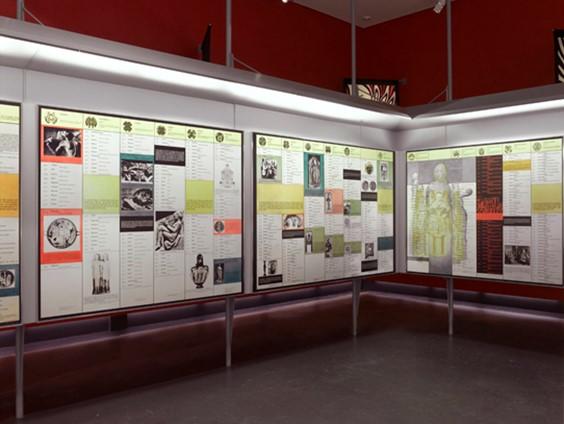
Caption
Brooklyn Museum, Heritage Panels An official website of the State of Georgia.
The .gov means it’s official.
Local, state, and federal government websites often end in .gov. State of Georgia government websites and email systems use “georgia.gov” or “ga.gov” at the end of the address. Before sharing sensitive or personal information, make sure you’re on an official state website.
Still not sure?
Call 1-800-GEORGIA to verify that a website is an official website of the State of Georgia.
LESSON PLAN: HISTORIC FIGURES IN THE HOLOCAUST
Grade 5 Standard
---------------------------------------------------------------------------------------------------
SS5H4 Explain America’s involvement in World War II.
d. Identify Roosevelt, Stalin, Churchill, Hirohito, Truman, Mussolini, and Hitler.
------------------------------------------------------------------------------------------------------
This lesson provides students with profiles and policies of the world leaders who led the Allies and the Axis Powers in World War II. Students learn about their contributions to the war and their responses to the Holocaust in each of their countries.
OVERVIEW: WHAT WAS THE HOLOCAUST?
The Holocaust was the state-sponsored, systematic persecution and annihilation of European Jewry by Nazi Germany, its allies and collaborators, between 1933 and 1945. Jews were the primary victims - six million were murdered.
Roma (Gypsies), physically and mentally disabled people and Poles were also targeted for destruction or decimation for racial, ethnic, or national reasons. Millions more, including the LGBTQ community, Jehovah's Witnesses, Soviet prisoners of war, and political opponents also suffered grievous oppression and death under Nazi tyranny.
By 1945, the Germans and their allies and collaborators killed nearly two out of every three European Jews as part of the "Final Solution." The "Final Solution" was the Nazi policy to murder the Jews of Europe.
Source: US Holocaust Memorial Museum Holocaust Encyclopedia: Introduction to the Holocaust
https://encyclopedia.ushmm.org/content/en/article/introduction-to-the-holocaust
NEW VOCABULARY
Systematic Done or acting according to a fixed plan or system; methodical.
State sponsored Actions organized by the civil government of a country
Persecution To harass or punish in a manner designed to injure, hurt or remove rights; grieve, or afflict
Collaboration To work with another person or group in order to achieve or do something.
German authorities required the assistance of local people in the regions they occupied to implement the "Final Solution." These collaborators helped to commit some of the worst crimes of the Holocaust era.
RESOURCE: ANIMATED MAP - THE HOLOCAUST
https://encyclopedia.ushmm.org/content/en/gallery/introduction-to-the-holocaust-maps
INSTRUCTIONS
National Archives Primary Source Analysis Worksheets
Worksheets for Novice or Younger Students, or Those Learning English
Worksheets for Intermediate or Secondary Students
Worksheet for Understanding Perspective in Primary Sources - For All Students and Document Types
This tool helps students identify perspective in primary sources and understand how backgrounds, beliefs, and experiences shape point of view.
Understanding Perspective in Primary Sources
LINK FOR HOLOCAUST GLOSSARY
LINK FOR HOLOCAUST CHRONOLOGY
PROJECT
Using the resources included for their assigned leader, students in each group will create an obituary for their world leader. The template for the obituary is attached here. Students will share their obituary with the class.
OR
Using the resources in their packet, students will create a full size exhibit panel about their assigned world leader.
RESOURCES
Writing a short biography with obituaries – NYT Article and Lesson Plan
Activity – Creating a Museum Exhibit
Ask students if they have ever visited a museum. If so, ask them what they saw and experienced. Brainstorm reasons museums collect and exhibit photographs, documents, maps, videos and artifacts.
Show students photos of different museum exhibits. What objects, photographs, videos, labels, or other materials are in each exhibit? What similarities and differences do they see between exhibits? What story is each exhibit telling?
Lead students in making their own mini museum exhibits, either in a hard copy or a virtual exhibit.
Students will:
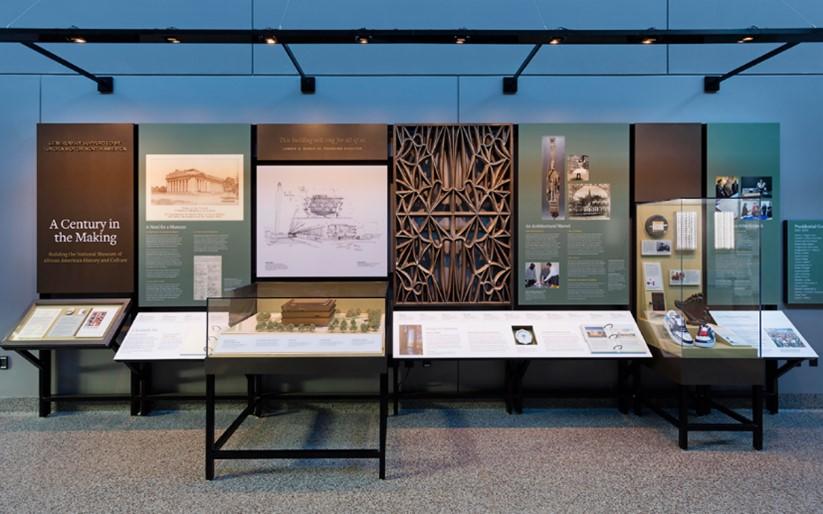
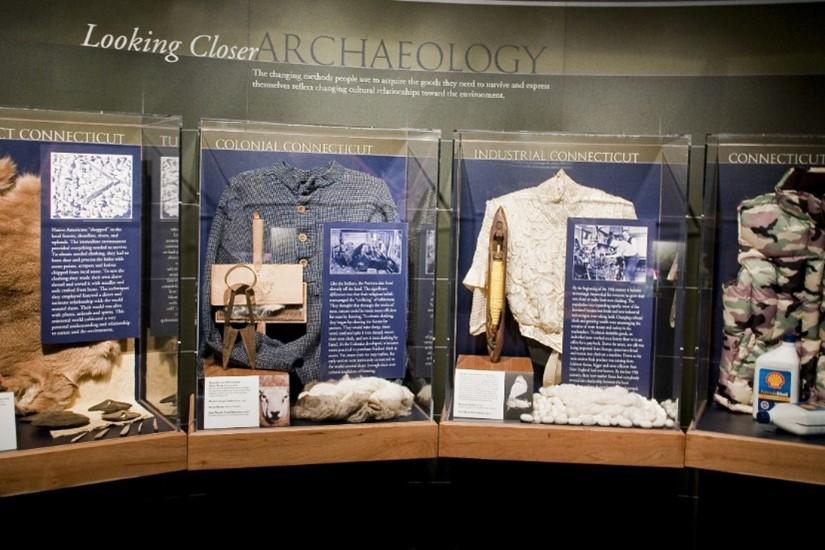
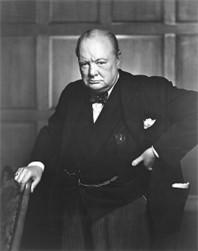
Photo courtesy of Library and Archives Canada / Bibliotheque et Archives Canada
Resources:
UK Government History – Past Prime Ministers: Winston Churchill website:
https://www.gov.uk/government/history/past-prime-ministers/winston-churchill
Library of Congress – Churchill and the Great Republic website:
https://www.loc.gov/exhibits/churchill/wc-hour.html
Imperial War Museum: How Churchill Led Britain to Victory in the Second World War website:
https://www.iwm.org.uk/history/how-churchill-led-britain-to-victory-in-the-second-world-war
The National Archives UK – Churchill’s reaction to the Holocaust website:
https://www.nationalarchives.gov.uk/education/resources/holocaust/churchills-reaction/
BBC Churchill and the Holocaust website:
https://www.bbc.co.uk/history/worldwars/genocide/churchill_holocaust_01.shtml
Critical Thinking Questions
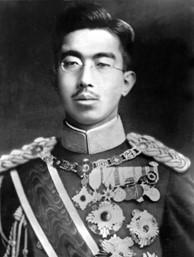
Japanese Emperor Hirohito
Photo courtesy of Associated Press
Resources:
New York Times: Aide’s Diary Suggests Hirohito Agonized over His War Responsibility:
https://www.nytimes.com/2018/08/24/world/asia/japan-hirohito-war-diary.html
American propaganda poster with anti-Nazi and anti-Japanese caricatures
https://collections.ushmm.org/search/catalog/irn520990
New York Times: Before Pearl Harbor, Emperor Warned Against War
The Gilder Lehrman Institute of American History: Japan declares war, 1941 - A Spotlight on a Primary Source by Hirohito, Emperor of Japan
https://www.gilderlehrman.org/history-resources/spotlight-primary-source/japan-declares-war-1941
USHMM Collections - Arthur Szyk drawing:
https://collections.ushmm.org/search/catalog/irn520300
USHMM Holocaust Encyclopedia – Axis Powers in World War II:
https://encyclopedia.ushmm.org/content/en/article/axis-powers-in-world-war-ii
Critical Thinking Questions
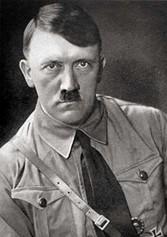
Adolf Hitler
Photo courtesy of Library of Congress
Resources
The National World War II Museum - How Did Adolf Hitler Happen?
https://www.nationalww2museum.org/war/articles/how-did-adolf-hitler-happen
USHMM Holocaust Encyclopedia - Adolf Hitler
https://encyclopedia.ushmm.org/content/en/article/adolf-hitler
USHMM Holocaust Encyclopedia -Making a Leader
https://encyclopedia.ushmm.org/content/en/article/making-a-leader?series=4
USHMM Holocaust Encyclopedia - Adolf Hitler – Early Years 1889–1913
https://encyclopedia.ushmm.org/content/en/article/adolf-hitler-early-years-1889-1913?series=4
USHMM Holocaust Encyclopedia - Adolf Hitler and World War I 1913–1919
https://encyclopedia.ushmm.org/content/en/article/adolf-hitler-and-world-war-i-1913-1919?series=4
USHMM Holocaust Encyclopedia - Adolf Hitler 1919 – 1924
https://encyclopedia.ushmm.org/content/en/article/adolf-hitler-1919-1924?series=4
USHMM Holocaust Encyclopedia - Adolf Hitler 1924 – 1930
https://encyclopedia.ushmm.org/content/en/article/adolf-hitler-1924-1930?series=4
USHMM Holocaust Encyclopedia - Adolf Hitler 1930 – 1933
https://encyclopedia.ushmm.org/content/en/article/adolf-hitler-1930-1933?series=4
USHMM Holocaust Encyclopedia -The July 20 1944 Plot to Assassinate Adolf Hitler
Critical Thinking Questions
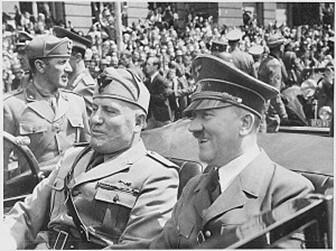
Benito Mussolini
Photo courtesy of The National Archives (540151)
Resources:
USHMM Holocaust Encyclopedia:
https://encyclopedia.ushmm.org/content/en/article/benito-mussolini-1
PBS - The Dictator’s Playbook – Episode 3: Benito Mussolini website:
https://www.pbs.org/tpt/dictators-playbook/episodes/benito-mussolini/
Imperial War Museum Collections – Benito Amilcare Andrea Mussolini – website:
Critical Thinking Questions
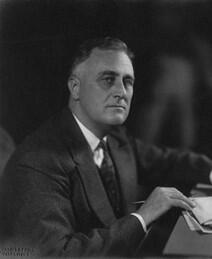
Franklin Delano Roosevelt
Photo Courtesy of FDR Library
Resources:
PBS American Experience website:
https://www.pbs.org/wgbh/americanexperience/features/eleanor-fdr/
USHMM Holocaust Encyclopedia Article:
https://encyclopedia.ushmm.org/content/en/article/franklin-delano-roosevelt
Franklin D. Roosevelt Presidential Library and Museum website:
https://www.fdrlibrary.org/fdr
The White House/Franklin D. Roosevelt website:
https://www.whitehouse.gov/about-the-white-house/presidents/franklin-d-roosevelt/
USHMM Video – Keep Out of This War
https://exhibitions.ushmm.org/americans-and-the-holocaust
Critical Thinking Questions
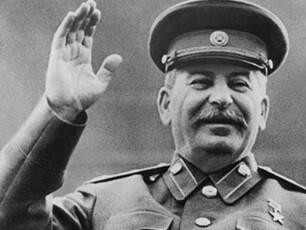
Joseph Stalin
Photo courtesy of Newsweek.
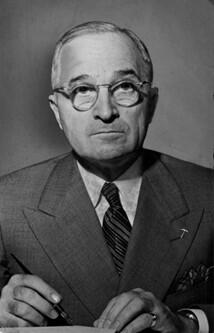
Harry S. Truman
Photo courtesy of The New York Times
Resources:
The White House – Harry S. Truman
https://www.whitehouse.gov/about-the-white-house/presidents/harry-s-truman/
Harry S. Truman Library * Museum - Biographical Sketch: Harry S. Truman, 33rd President of the United States
https://www.trumanlibrary.gov/education/trivia/biographical-sketch-harry-truman
The White House Historical Association – Harry S. Truman
https://www.whitehousehistory.org/bios/harry-truman
National World War II Museum - "The Creed of Liberty" Harry Truman's Independence Day Message, July 4, 1945
https://www.nationalww2museum.org/war/articles/truman-independence-day-message-1945
USHMM History Unfolded: US Newspapers and the Holocaust - President Truman Orders Quota Preference for Displaced Persons
https://newspapers.ushmm.org/events/president-truman-orders-quota-preference-for-displaced-persons
USHMM Film: Truman Proclaims Victory in Europe
https://encyclopedia.ushmm.org/content/en/film/truman-proclaims-victory-in-europe
Experiencing History: Letter from Dwight D. Eisenhower to Harry S. Truman September 18, 1945
DOCUMENT ANALYSIS
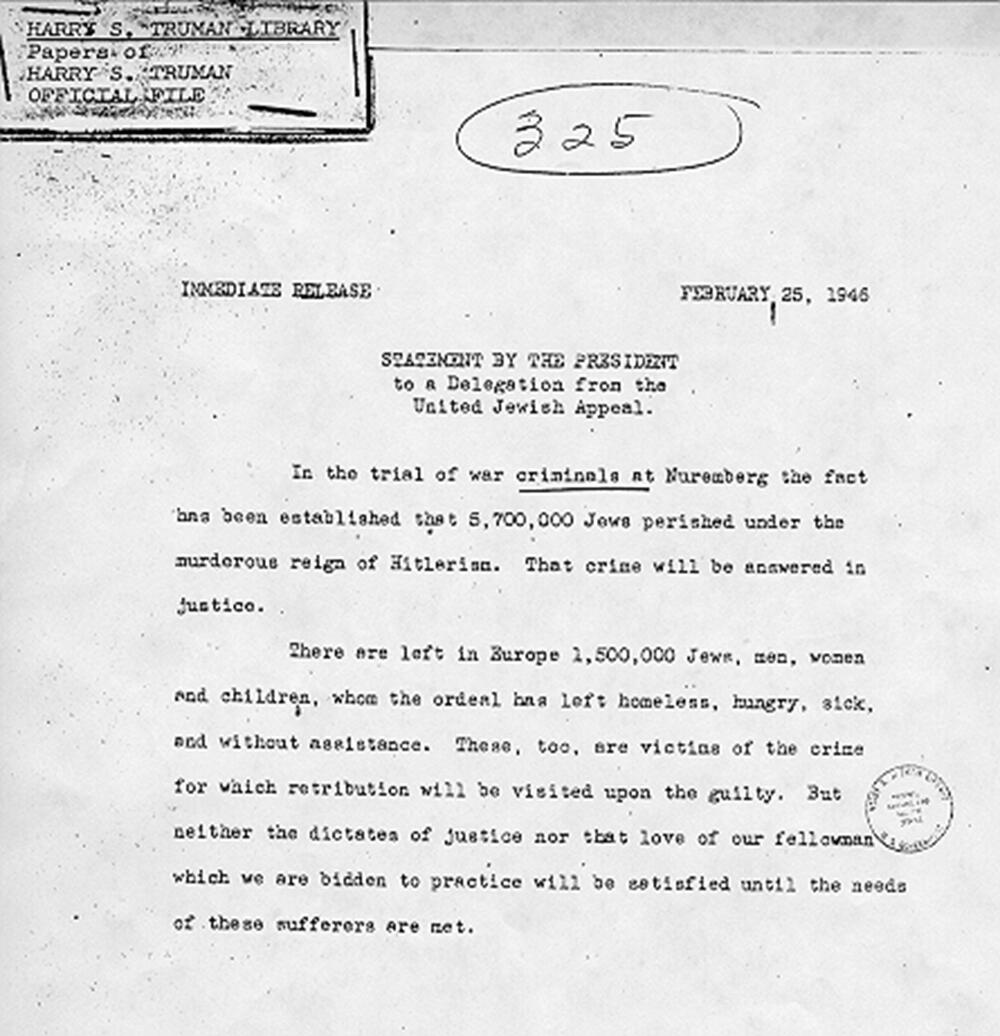
Anticipating the defeat of Germany in October of 1943, the Allies established a United Nations War Crimes Commission to collect evidence that could be used to prosecute Nazi war criminals. After the surrender of Germany, President Truman appointed Supreme Court Justice Robert Jackson as chief counsel to investigate and try Nazi war criminals. From November 1945 until October 1946, the International Military Tribunal, in the former Nazi stronghold of Nuremburg, heard cases against 22 senior, Nazi leaders. The court sentenced twelve to death and three to life sentences. Hundreds of other lesser figures in the Nazi conspiracy (what Truman called "second stringers") were tried from January 1946 to April 1949. The Office of Military Government found 185 more Nazis guilty of war crimes.
Document-Survey: Questions